Sergeyich and Petro’s relationship
Grey BeesSergey Sergeyich and Petro’s relationship grows from a chance encounter between a beekeeper and a soldier into a modest, reciprocal friendship shaped by practical aid. Petro first arrives as an armed stranger who has watched the village from a distance; later he returns with food, keeps his promise to charge Sergeyich’s phone, and accepts the beekeeper’s warning about a sniper’s position. Their exchanges do not erase the danger around them, but they make trust tangible: in tea and honey, a grenade left for self-defence, and a telephone number that replaces improvised signals.
First Visit: Stranger and Host
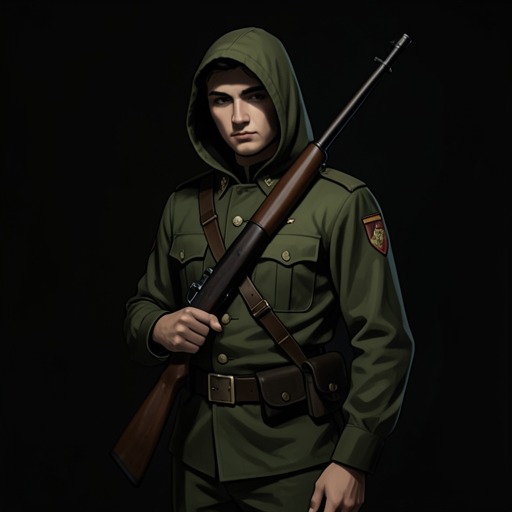
The relationship begins when Sergey Sergeyich opens his door expecting Pashka and instead finds Petro, a younger man in camouflage with a rifle slung over his shoulder. The meeting is startling, but Petro’s manner is courteous. He introduces himself by name and says he has watched Sergey Sergeyich for more than a year through binoculars, as part of his duty to observe the village. He has come at night because approaching in daylight is dangerous, though he is not really permitted to enter after dark either.
The distance between observer and observed narrows over tea. Sergey Sergeyich makes a cup for each of them and offers honey; Petro explains that he is from Khmelnytskyi and describes a country where people are still being cheated and streets and towns renamed, while holding out hope that after the war travel abroad will no longer require permission. Their talk establishes a tentative familiarity without pretending that they share the same circumstances. Petro is a soldier on watch; Sergey Sergeyich is a villager whose home lies in the path of the conflict.
When Sergey Sergeyich offers honey to take away, Petro declines at first, saying he is not leaving yet and does not need any, then agrees to have some with his tea. This small hesitation sets the pattern for their friendship: help is offered without ceremony, accepted in practical amounts, and allowed to become part of an ordinary visit.
Gifts and Practical Trust
At the end of that first visit, Petro takes his rifle from the chair and sets an R.G.D.-5 grenade beside his teacup as a gift. He explains that it is for self-defence and that, if it remains unused, Sergey Sergeyich can bury it in the garden after the war. The present makes the threat surrounding the household concrete, but it also expresses Petro’s concern for his host. It is an unsettling form of hospitality: a weapon offered alongside tea and honey.
Petro also offers to charge Sergey Sergeyich’s mobile phone using the soldiers’ generator, which can power even a washing machine. Sergey Sergeyich gives him the phone and charger. On a later visit, Petro returns both, already charged, and leaves his telephone number on a piece of paper. He tells Sergey Sergeyich that he can now text or call in an emergency instead of hanging rags on trees. Keeping this promise matters to Sergey Sergeyich, who thanks him for being a man of his word. A borrowed charger has become a dependable line of contact.
Their exchanges are not limited to objects. On another visit, Petro arrives with a backpack of food, but Sergey Sergeyich says he has already gone to Svitle and traded honey for eggs. He offers to fry noodles with an egg for his guest. The scene reverses the expected direction of aid: the soldier brings supplies, yet the beekeeper has food to share and insists on feeding him. Petro’s visits allow both men to give and receive, rather than fixing one as rescuer and the other as dependent.
Shared Knowledge of Danger
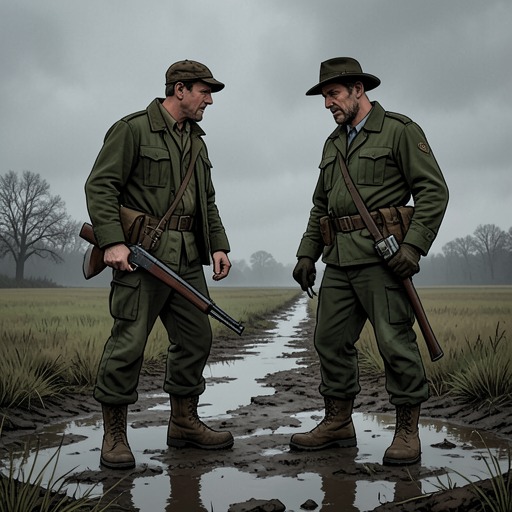
Petro brings news that someone has taken away the dead man who had been in the field, probably separatists from Karuselino. Sergey Sergeyich tells him that he was the one who covered the body with snow and that the man is still outside. Petro is astonished at the risk Sergey Sergeyich took; the beekeeper says he went out at night, while everyone slept. Their exchange gives Petro a view of his host not just as someone he has observed through binoculars, but as a person who has acted in the dangerous space the soldier is tasked with watching.
Sergey Sergeyich, in turn, passes along information of his own. After Petro has started back across the field, the beekeeper remembers the sniper’s bed and calls him back to show him what he found near the Krupins’ home. Petro’s manner changes: he had seemed a little tipsy, but becomes completely sober as he takes in the warning. He thanks Sergey Sergeyich seriously, shakes his hand, and walks away from the position without stooping or lowering his head. The moment makes their trust reciprocal. Sergey Sergeyich offers information that could matter to Petro’s safety, and Petro receives it as more than casual conversation.
A Friendship Made of Exchanges
Food, honey, and assistance give the relationship its everyday texture. Sergey Sergeyich’s offer of honey and tea, Petro’s gift of the grenade, the charged phone, and the later backpack of food form an exchange that is not governed by a clear price. Each gesture answers a need, but also recognizes the other man as someone worth looking after. The friendship remains grounded in the conditions that limit it: Petro comes armed and under the cover of darkness, while Sergey Sergeyich lives in a village where food and communication can be uncertain.
The tie also has consequences beyond the two men’s immediate visits. When Sergey Sergeyich explains to Aisylu that he brought her candles and that they came from his bombed church, he identifies himself as someone who has carried goods and goodwill across the lines of ordinary daily life. That scene does not establish that Petro arranged the candles, but it echoes the same pattern visible in their friendship: objects pass between people in dangerous circumstances and acquire meaning through the care behind their transfer.
Petro and Sergey Sergeyich do not become allies by sharing a complete account of the war or by resolving its dangers. Their bond is smaller and more concrete. A soldier who once watched the village from afar becomes a welcome visitor; a beekeeper who first meets him with uncertainty learns to rely on his word. The phone number, the returned charger, and the warning at the sniper’s position mark a friendship built not on grand declarations but on promises kept and attention returned.